External data sources
The external data sources services allow to search, in read-only mode, the data available in the Copernicus ground segment. The Copernicus services expose their data with the OData protocol: rs-server translates the STAC API requests of the users into OData requests, and the OData responses into STAC items (see STAC mapping of external data). The users only deal with STAC.
To copy the data into the RS-Python object storage and catalog, use the staging.
| Service | Endpoint | Data | Swagger section |
|---|---|---|---|
| CADIP | /cadip |
Raw data sessions of the acquisition stations | CADIP stations |
| AUXIP | /auxip |
Auxiliary data | ADGS stations |
| PRIP | /prip |
Level-0, Level-1 and Level-2 products of the production services | PRIP stations |
All of them implement the same STAC API endpoints (landing page, collections, items, search, queryables,
sortables), described in Browse products.
Each user only sees the stations for which they have the rs_<service>_<station>_read role, see
User rights.
CADIP stations
The CADU Interface delivery Point (CADIP) is the interface of the Copernicus acquisition ground stations. It delivers the raw data (CADU, Channel Access Data Unit) downlinked by the satellites, organised in sessions: a session contains the data acquired during one pass of a satellite over a station, split into several files (DSDB files) per channel.
rs-server maps each CADIP session to a STAC item (identified by its session ID, e.g.
S1A_20170501121534062343) and each file of the session to a STAC asset. The metadata of the sessions are
described by the CADIP STAC extension (cadip: prefix).
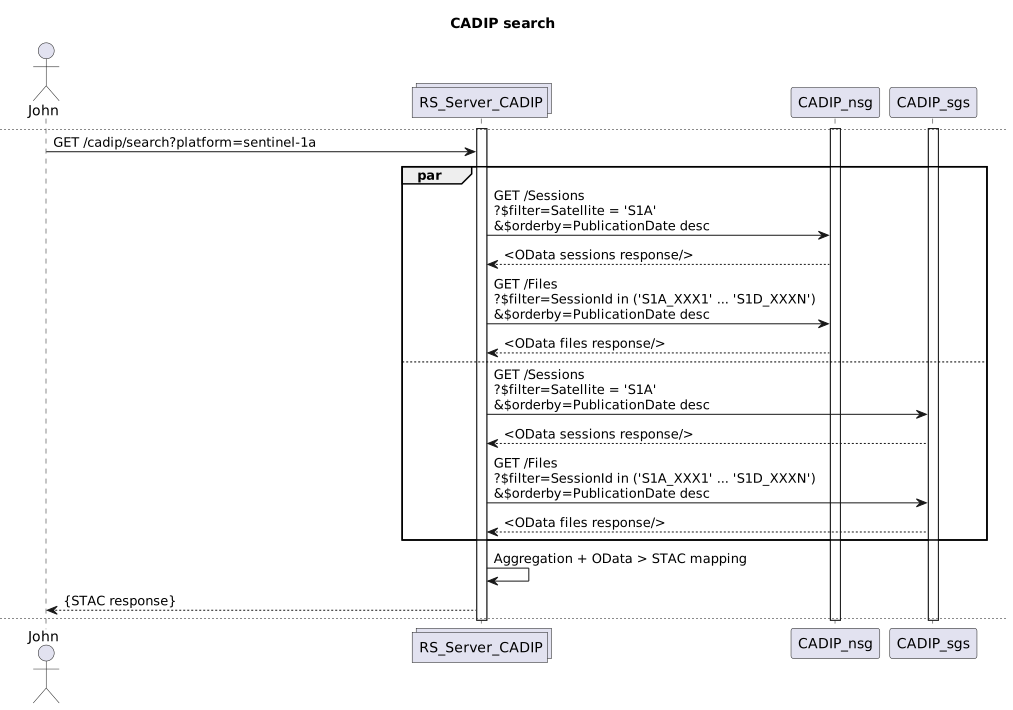
Getting the items of a collection requires two requests to the station: one to get the sessions, one to get their files:
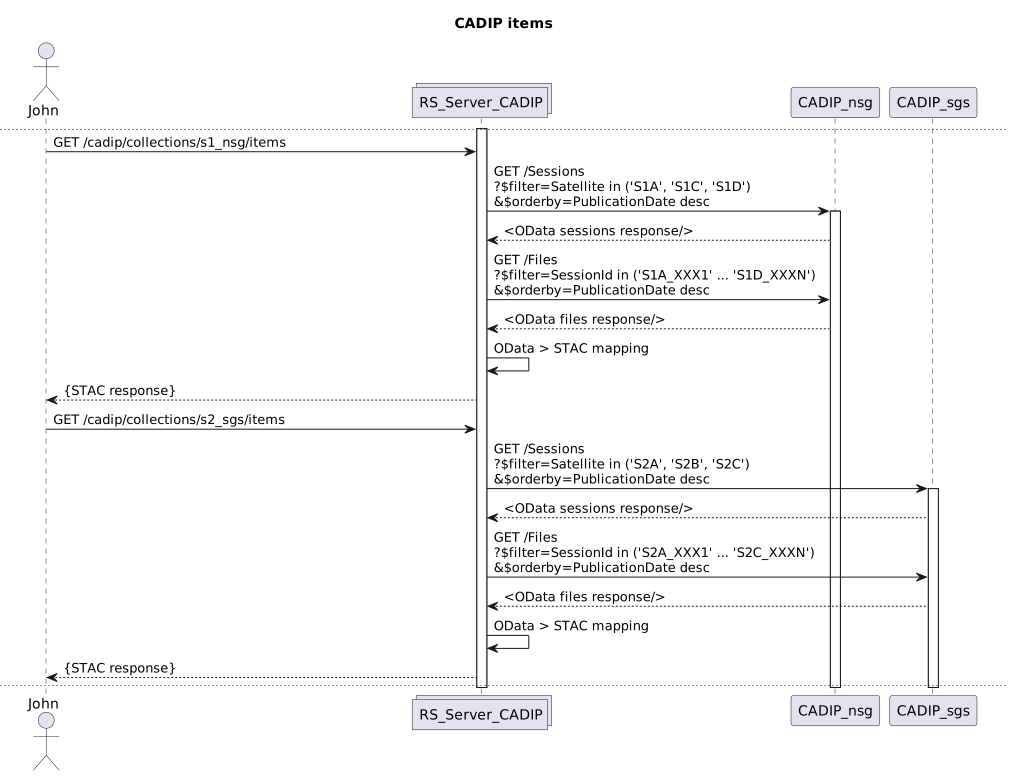
AUXIP (ADGS) instances
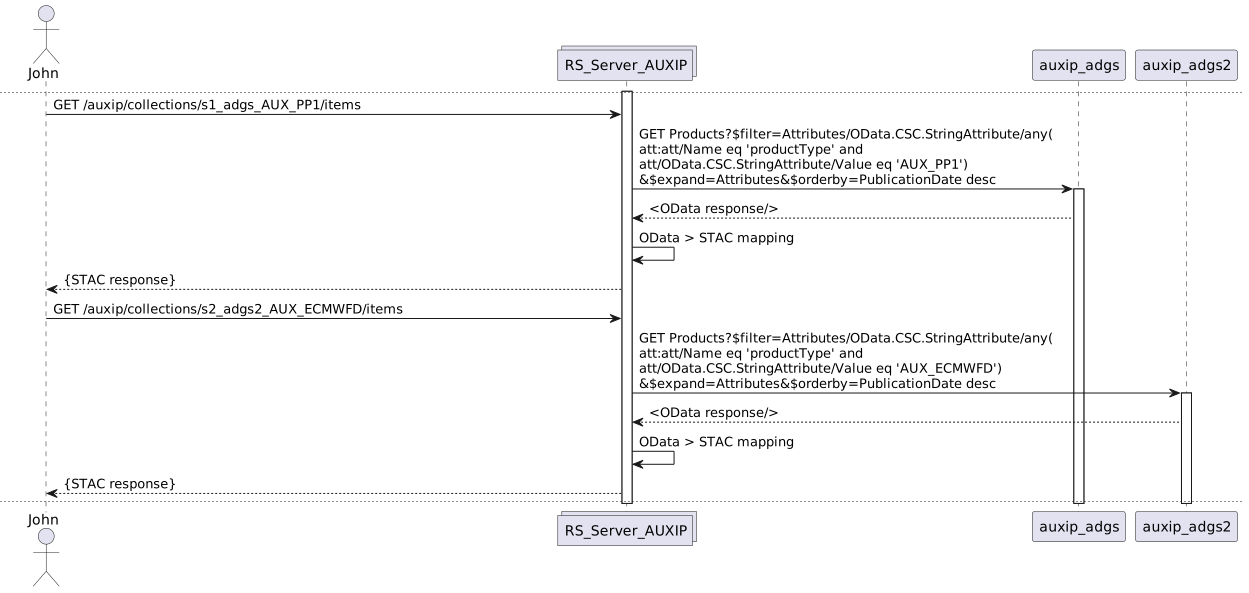
The Auxiliary Data Gathering Service (ADGS) delivers the auxiliary data files used by the processors (orbit files, meteorological data, calibration files...) through an AUXIP (AUXiliary data Interface delivery Point) interface. rs-server maps each auxiliary file to a STAC item with a single asset, identified by the file name without its extension.
PRIP instances
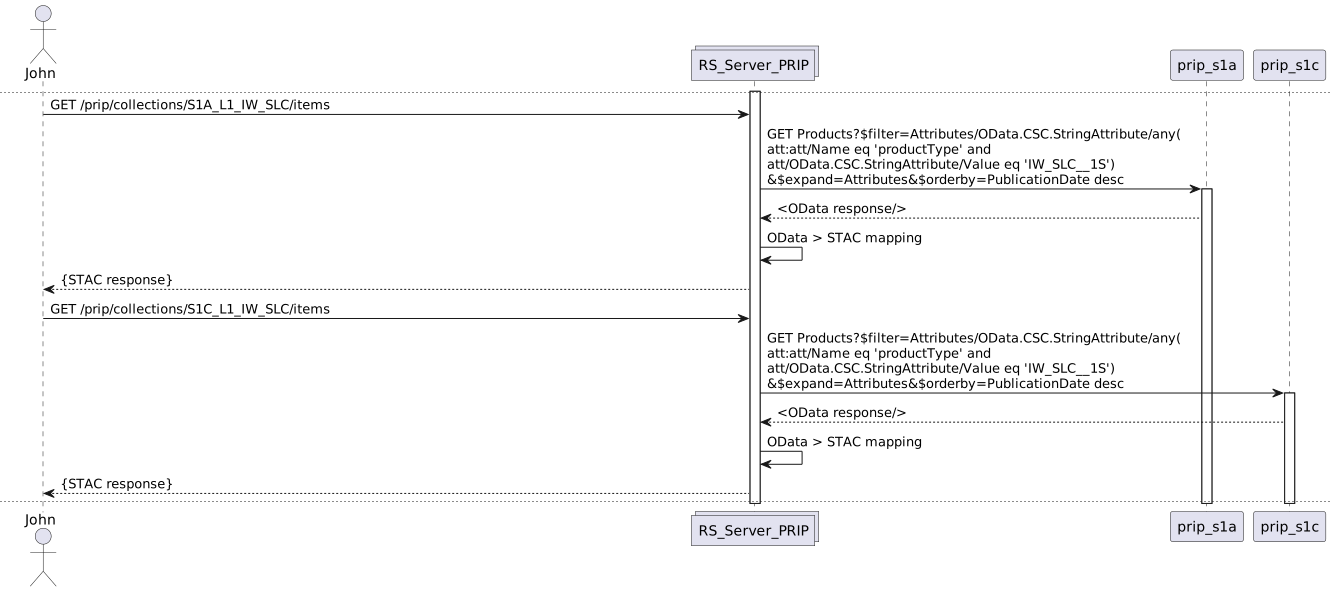
The Production service Interface delivery Point (PRIP)
is the interface of the Copernicus production services, one per satellite. It delivers the Level-0, Level-1 and
Level-2 products. rs-server maps each product to a STAC item with a single asset, and converts the legacy product
types to the EOPF product types (e.g. IW_SLC__1S to S01SIWSLC) with the
product type mapping.
Other data sources
| Data source | Access |
|---|---|
| Copernicus Data Space Ecosystem (CDSE) | Its public STAC API is called directly by the rs-client-libraries (CdseClient), e.g. to find auxiliary data. Its products can be staged from its S3 object storage. |
| EarthDataHub of Destination Earth | Its public STAC API is called directly by the rs-client-libraries (EarthDataHubClient), e.g. to find the Copernicus Digital Elevation Model. |
| Long Term Archive (LTA), European Data Relay System (EDRS) | Not exposed by rs-server. The mockups of the LTA are available for the tests. |
Collections
The collections of the stations are virtual: they are not stored in a database, but defined in the
configuration of rs-server, to give a view of the content of a station. A collection can contain e.g. all the
sessions of a CADIP station, or only the products of a given type from a PRIP instance. They are defined in the
*_search_config.yaml files of the services (e.g. in the
rs-server-prip Helm chart for the
cluster mode):
collections:
- id: S1A_L0_IW_RAW          # collection identifier
  station: s1a               # station that contains the data, as configured in the station secrets
  query:                     # optional OData filter, to select a subset of the station data
    productType: IW_RAW__0N
  title: Sentinel-1A IW RAW products from the PRIP
  description: ...
  license: other
  extent: ...                # usual STAC collection fields
  links: ...
  providers: ...
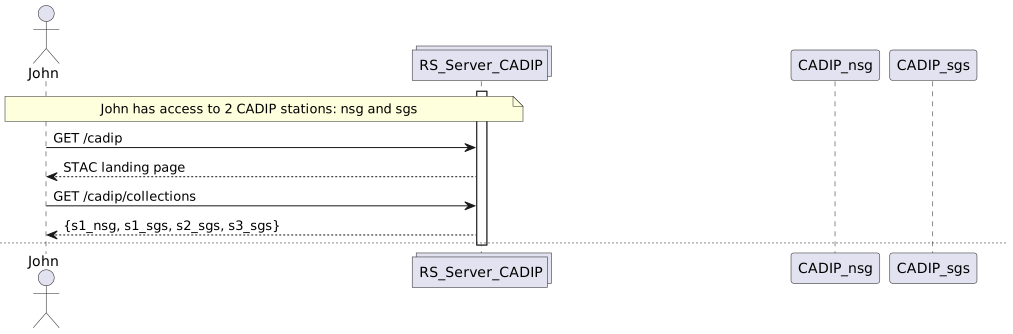
The /<service>/collections endpoint only returns the collections of the stations that you are allowed to read.
For AUXIP and PRIP, use complete STAC platform names to restrict a collection to specific satellites:
platform accepts a YAML list or a comma-separated string. It preserves the association between
the constellation and serial identifier: this example selects S1A or S2B, never S1B or S2A.
Names are case-insensitive in the collection configuration. An empty list selects no products.
The existing platformShortName and platformSerialIdentifier fields remain independent restrictions;
their lists are not paired by position. When combined with platform, all restrictions must match.
Search requests are intersected with each selected collection. Collections on the same station
are combined as complete alternatives, preserving their satellite and product-type restrictions.
When collections is omitted, the same rules apply to all collections the user is allowed to read.
OData applies these filters before sorting and pagination.
Access to the stations
The URLs and credentials of the stations are set by the administrators in the rs-server-station-secrets
configuration (see Update rs-server parameters).
rs-server gets an OAuth2 token from each station and keeps it up to date:
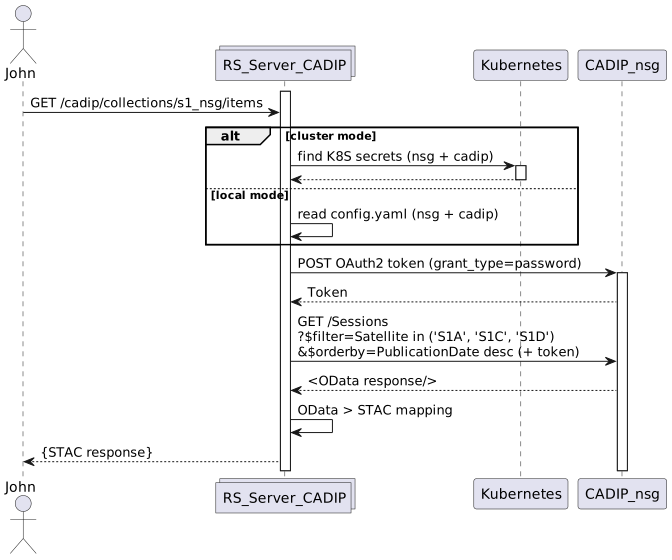
On the development and test platforms, the stations are replaced by the mockups of rs-testmeans.
Search across several stations
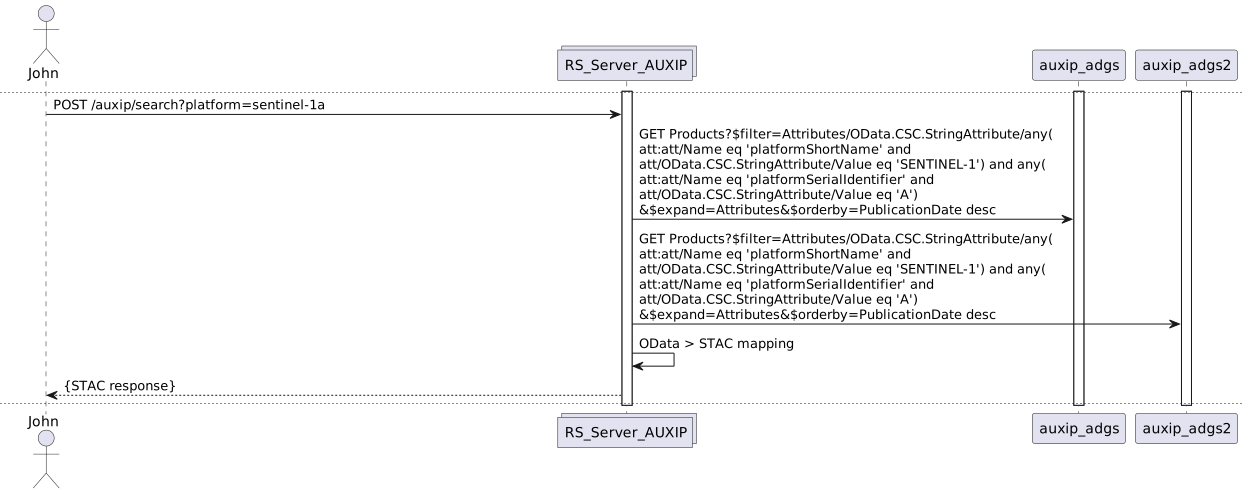
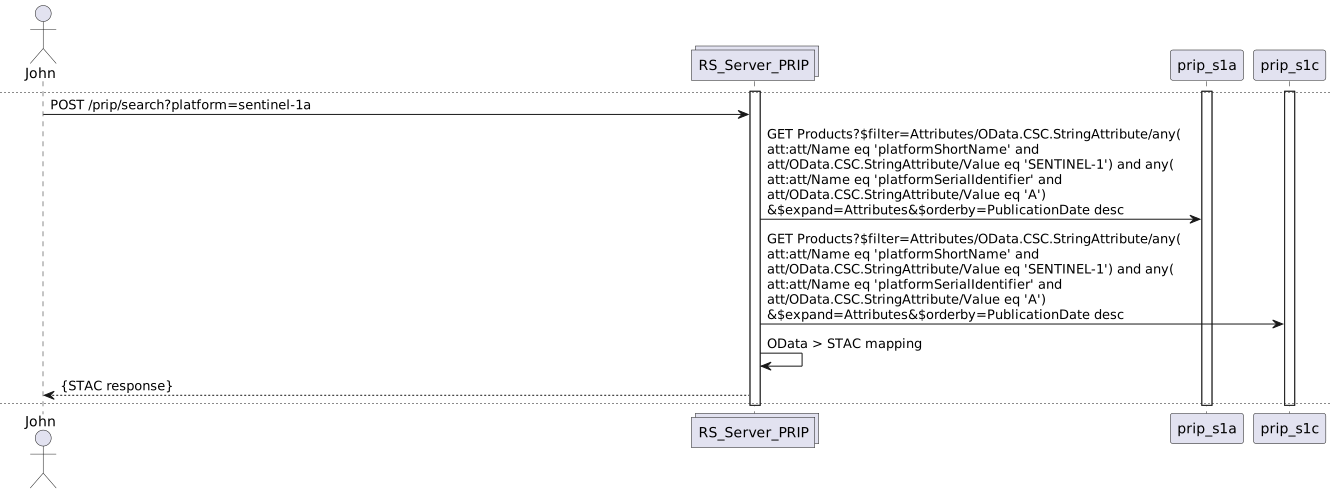
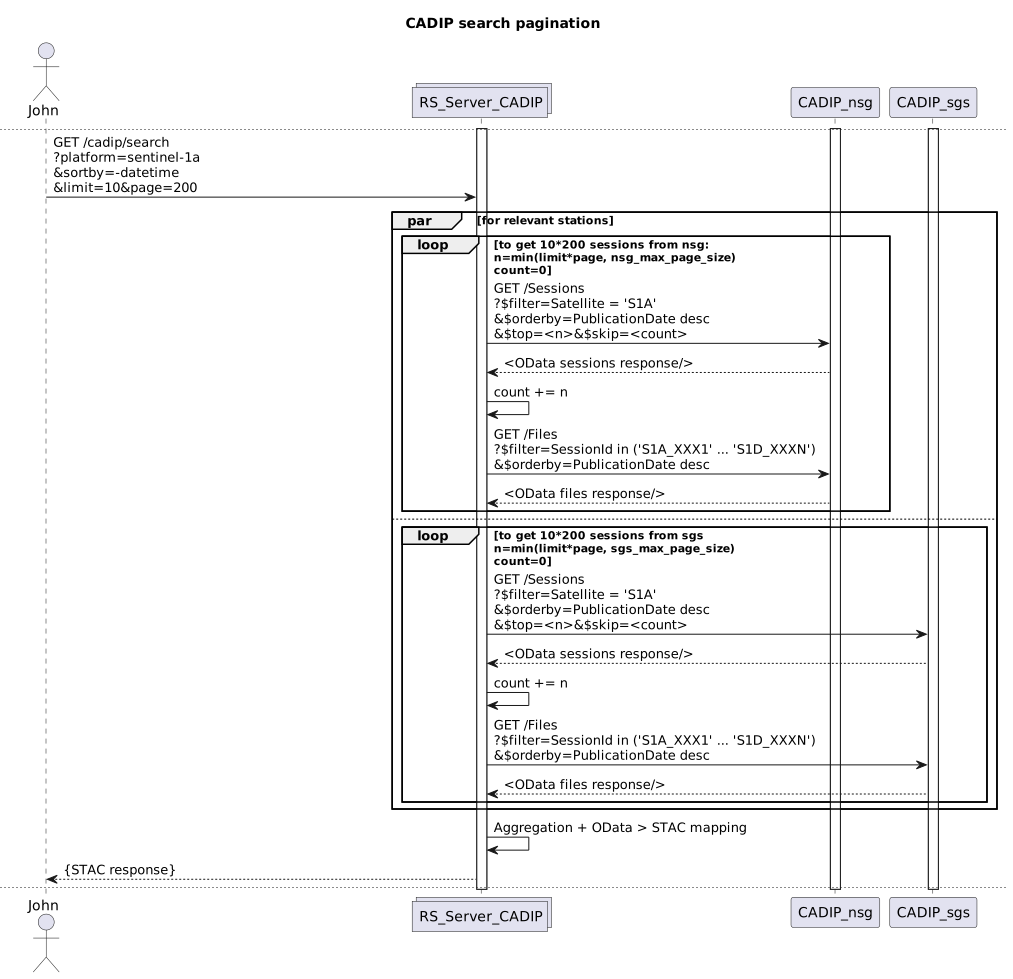
A search on several collections or stations (/<service>/search) sends one OData request per station, then
aggregates and paginates the results:
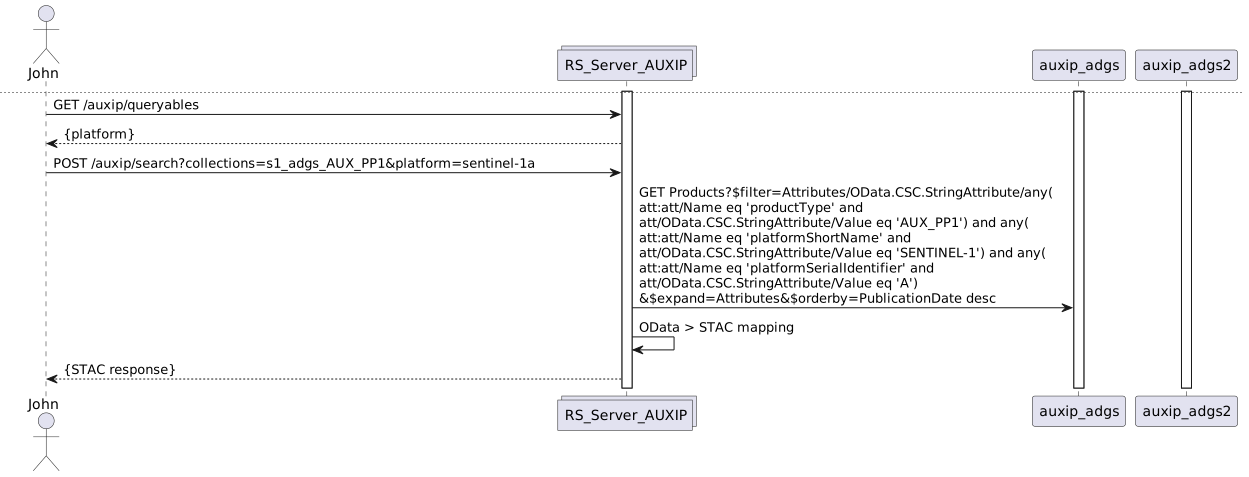
The landing page, collections and queryables requests are answered from the configuration:
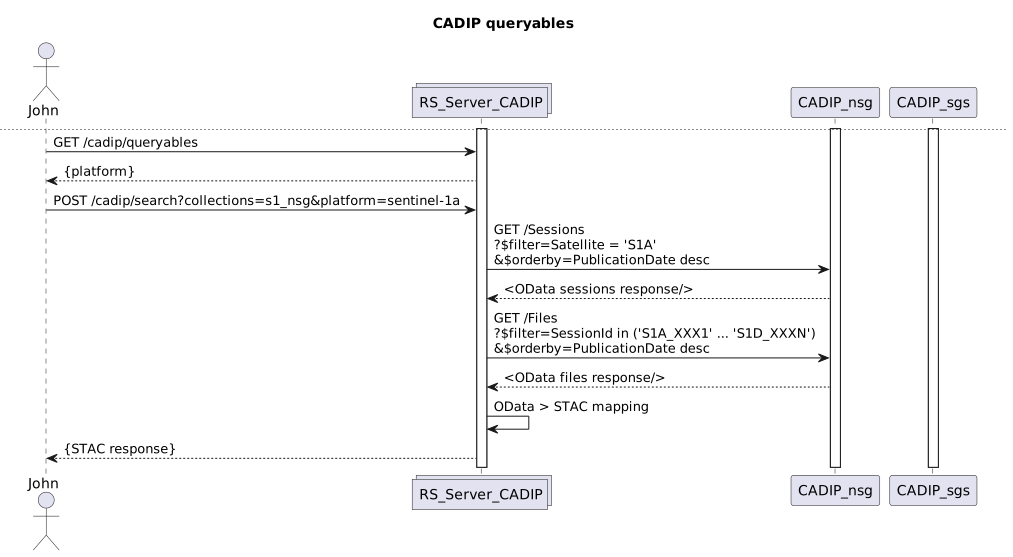
The AUXIP and PRIP services behave the same way: