Administration
This section is dedicated to the RS-Python administrators. It assumes a good knowledge of Kubernetes, Helm, Ansible, Terraform and Keycloak.
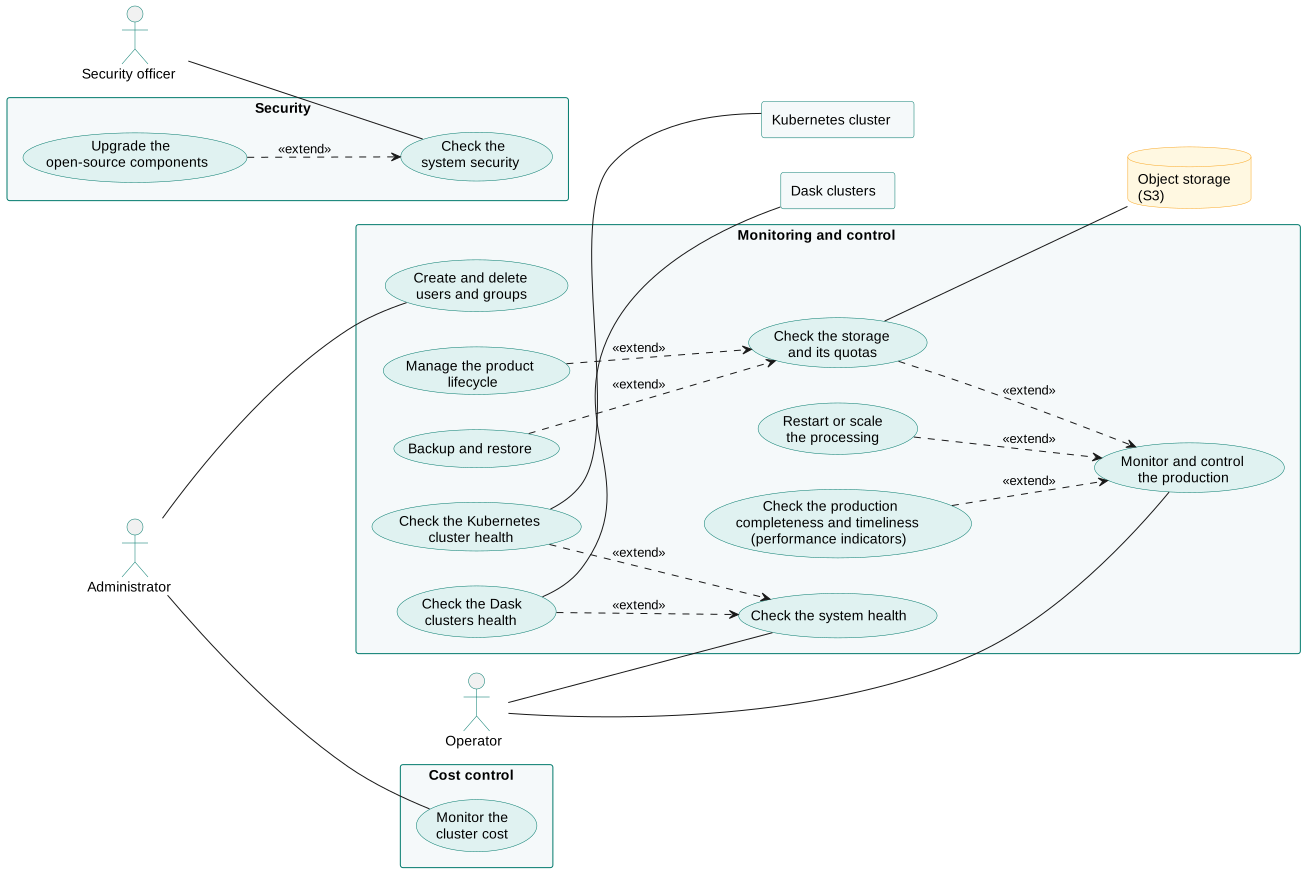
The administrators are present during the whole project lifetime, not only during the development phase. Their tasks are:
| Task | Documentation |
|---|---|
| Deploy the platform from scratch: Kubernetes cluster, infrastructure, monitoring, virtual environment, RS-Python services and flows. | Deploy RS-Python |
| Modify the configuration of a running platform. | Update infrastructure parameters, Update rs-server parameters |
| Add users, assign and synchronise their rights. | Create accounts and assign permissions |
| Initialise the processing environment of a user group after the deployment: Prefect blocks and variables, Dask clusters, default flows. | Initialise the processing environment |
| Monitor the platform: logs, metrics, traces, resources and costs, to troubleshoot errors and bad performances. | Monitoring and observability, Object storage quota monitoring, Performance indicators |
| Operate the cluster: start and stop, backup and restore, credentials... | Operations how-to pages of the navigation menu, from rs-infra-core |
| Support the users who face difficulties. | Troubleshooting |
The operators use a subset of these tools, mainly the monitoring ones, to check the health of the system and the completeness and timeliness of the production.
Administration use cases
The deployment use cases are described in Deploy RS-Python.